






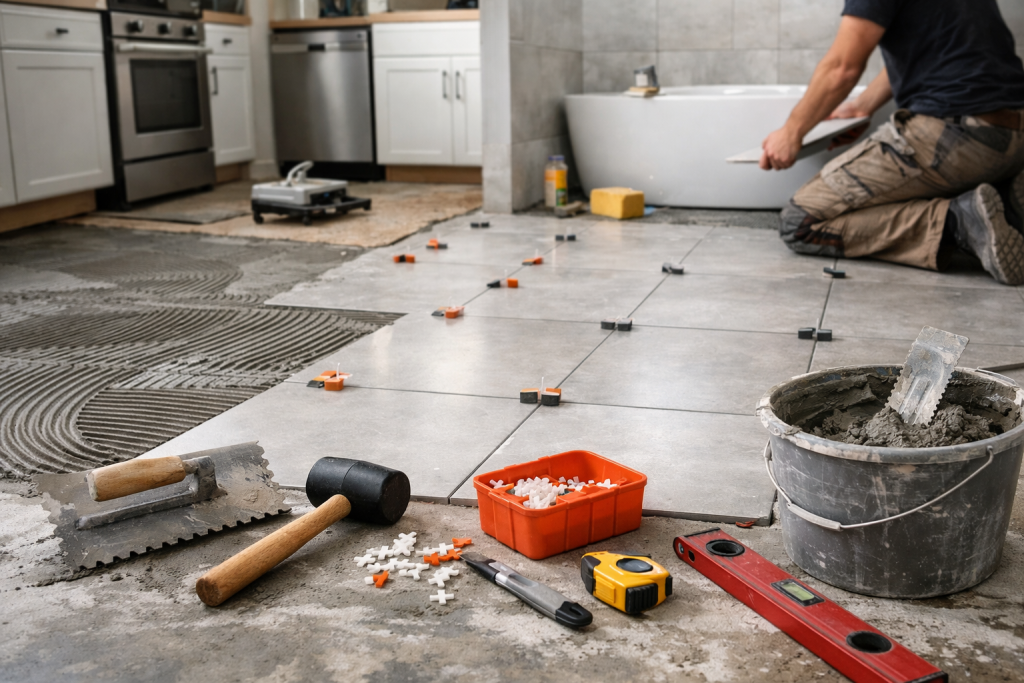
Your kitchen and bathroom floors play significant roles in ensuring the comfort, safety, and overall aesthetic appearance of these areas. Tiling the bathroom and kitchen is a better option; however, achieving this may be frustrating if you do not know how it works.
Tiling involves both tactical and manual work, and the two go hand in hand. While you may decide to let the experts tile your home, learning all that is involved in the installation process is necessary.
8 Tips for Tiling Your Kitchen and Bathroom Floor
Tip 1: Get an accurate measurement of the square footage areas
Tiling, like most home construction projects, requires planning and precision. You need to take certain steps to ensure you get the best outcome. One of the most important things to do before tiling your kitchen and bathroom floors is to get the square footage measurements. An accurate measurement will help you calculate the installation cost and create a budget.
The best way to get accurate measurements is to hire an expert; however, if you can get accurate results, you can do the measurements yourself. The square footage measurements of your kitchen and bathroom are used to determine how and what to prepare for the tile installation.
Tip 2: Consider the tile type
The kitchen and bathroom are the most-used areas of a home; hence, the need to consider durability when choosing a tile type for them. The tile you choose determines your budget for both labour and materials, which is why you need to consider the type you need when creating a plan for your tiling project. You can ask for professional advice on the tiles to choose, to avoid settling for less.
Tip 3: You need a tile installation cost calculator
We mentioned earlier that tile installation requires planning and precision. You need to ensure you have a precise estimate of the cost of the labour and materials you need to tile your kitchen and bathroom. This is where a tile installation cost calculator comes in.
A tile installation cost calculator is the best tool for calculating labour and materials for a tiling project. All you need to do is enter the dimensions of your kitchen and bathroom, select the materials needed, and get an accurate cost breakdown for your tiling project. You can find several tile installation cost calculators online; however, a few stand out. Material calculators like the Calcforhomes tile installation cost calculator and a few others are reliable and designed to provide accurate results for every tiling project.
Tip 4: Create a budget
Every project requires a budget to help control and monitor expenses. However, creating a working budget requires more than unusual calculations. While calculations are the bedrock of a budget, planning plays a significant role too. So to ensure you have a working budget, you have to combine planning and calculations. Notwithstanding, ensure you add the correct figures when calculating, as a wrong calculation can alter the entire budget. Using a reliable material calculator can help you create the perfect budget for your tiling project.
Tip 5: Order extra tiling materials
Ensure you apply the 10% waste factor rule when ordering tiling materials. Waste factor in this context refers to the extra percentage of tiling materials added to the estimated cost to cover losses and damages. Losses are bound to happen during a tiling project; hence, the need to order extra materials before you begin. Reliable material calculators include the waste factor when creating estimates for a tiling project. Just ensure you enter the correct measurement and tiling materials.
Tip 6: Waterproofing is necessary
While some people may not consider waterproofing when tiling their kitchen and bathroom, it is an important step that shouldn’t be overlooked. Tiles are water-resistant, but that should not stop you from waterproofing, especially your bathroom floor. The consequences for not waterproofing your bathroom and kitchen do not appear immediately, but they eventually do in the long run. Waterproofing prevents mold growth, structural damage, and other effects that can threaten your comfort.
Tip 7: Pick a tile colour that appeals to you
The tile colour may seem like the least thing to worry about when tiling your kitchen and bathroom, but it usually ends up becoming a big deal. You will likely feel frustrated and irritated in the future if you pick a colour you can’t stand. Ensure you choose colours that appeal to you, to prevent future regrets.
Tip 8: Hire tile installation experts
If you are great at tiling, DIY isn’t a bad idea, but if you aren’t, hiring experts to get the job done is a better option. Tiling is one of those projects that requires a high level of professionalism to prevent mistakes. While DIY can help you save costs, it is not cost-effective if not properly installed. Hiring a professional guarantees accurate measurements and cost estimation for labour and materials.
Conclusion
Tiling your kitchen and bathroom is a crucial home construction project, and it requires only the best approach.